Hartwood: the real history of a Scottish asylum
Hartwood asylum's most famous facts were made up, while its real dead lay nameless for decades. What the records, the cemetery and the families show, and who Scotland still keeps in hospital today.
Jason Boyd
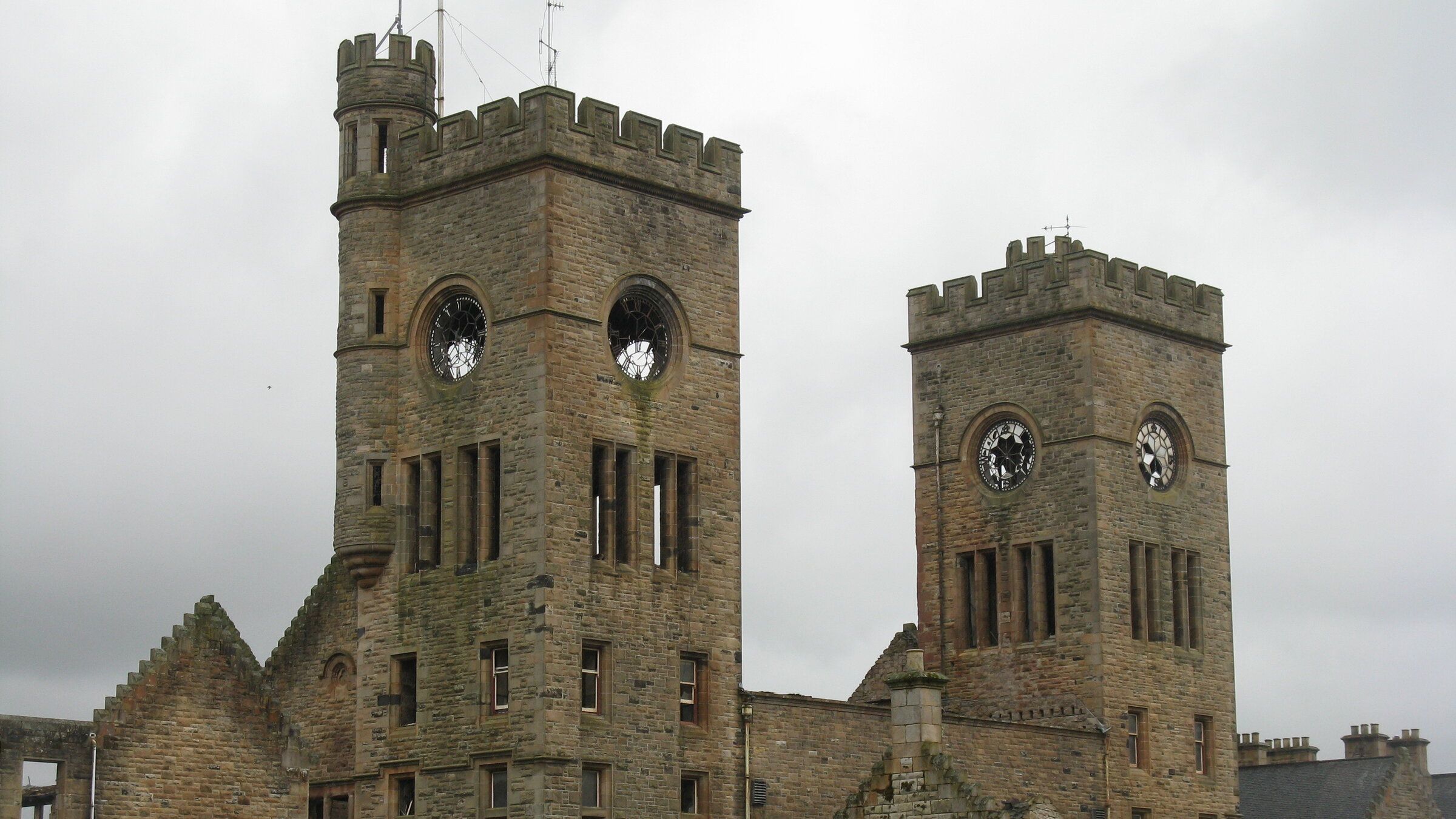
The skip
Some time in the 1990s, while Hartwood Hospital was being emptied, a man called Tony Fitzpatrick found its burial books in a skip. Tony was a local man who had worked at the hospital as a nurse. He took the books out and handed them in to the local heritage centre (National Lottery Good Causes; Friends of Hartwood Paupers Cemetery, 7 and 8 October 2026). They are now held by North Lanarkshire Archives. Tony has since died.
Between 24 August 1895 and 11 April 1952, 1,255 people were buried in the cemetery behind the hospital (Friends of Hartwood Paupers Cemetery). For most of that time, and for decades afterwards, the graves were rows of numbered iron plates, where there was a marker at all. From 2019, volunteers spent more than three years, much of it during the pandemic, matching the names in Tony’s books to the plots. Every one of the 1,255 is now named on boards on the site.
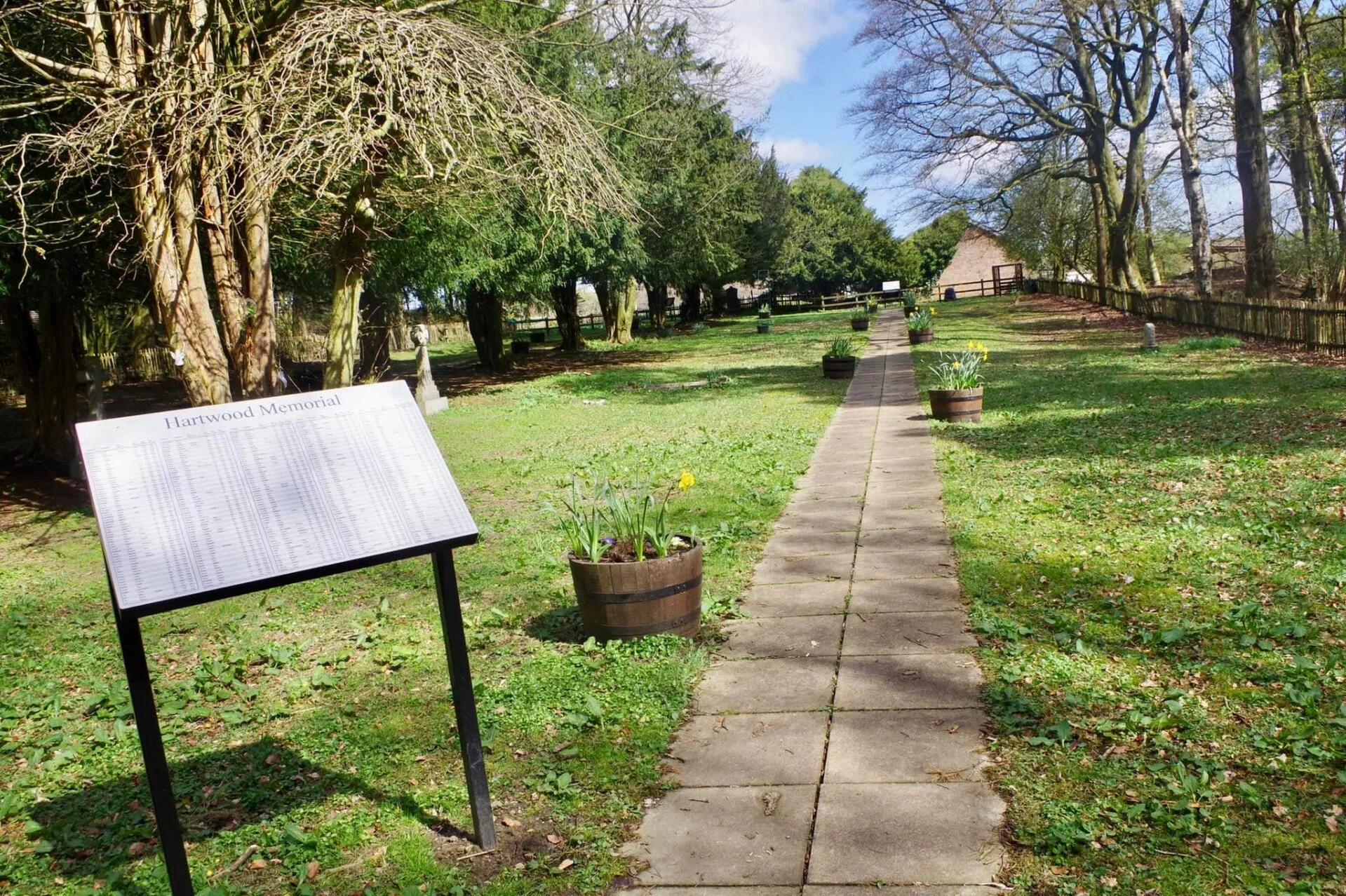 Hartwood’s cemetery today. Photo: Loraine Duncan FoHPC.
Hartwood’s real dead lay nameless for decades, while a history of the place that no one can source became famous. And people like those it was built to hold out of sight are still kept in Scotland’s hospitals for years, with nowhere else to go.
The man who built it is buried there too.
Cure where possible
In the far top corner of Hartwood’s cemetery stands the biggest memorial stone in the ground. It belongs to the asylum’s first medical superintendent, Dr Archibald Campbell Clark, buried on 2 December 1901 among the patients he had looked after (Friends of Hartwood Paupers Cemetery).
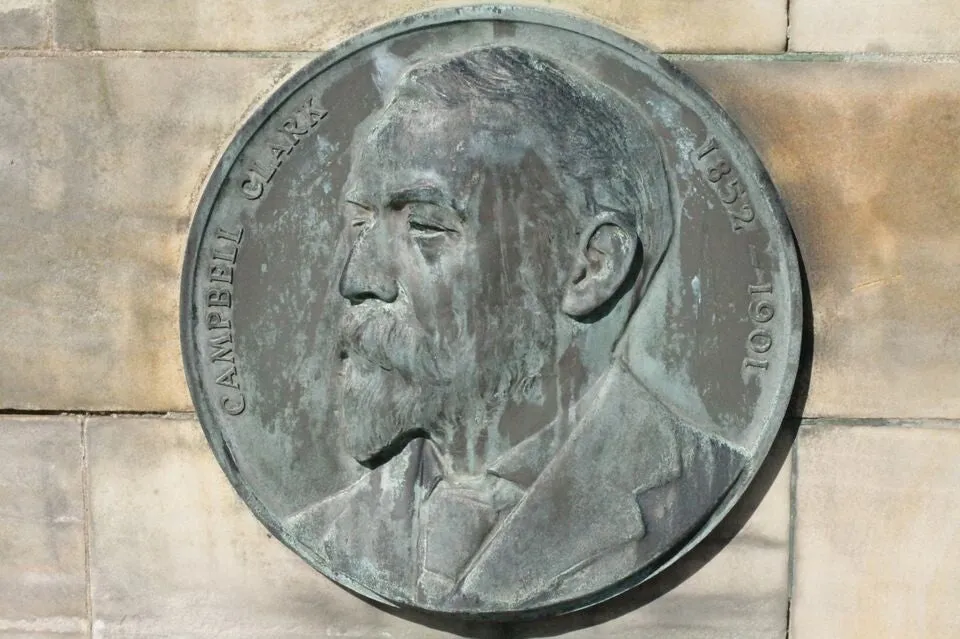 Dr Archibald Campbell Clark, Hartwood’s first medical superintendent, on a bronze plaque. Photo: Loraine Duncan FoHPC.
He was not a grand man by birth. He was born in Tarbert on Loch Fyne in 1852, the son of a merchant who died young, and grew up in Lochgilphead. As a teenager he took a job on the lay staff of the Argyll District Asylum there. His obituary says that seeing asylum work from that side “made a deep impression on him”, and that for the rest of his life he showed “much sympathy with the lay staff in their work” (Journal of Mental Science, 1902). He worked in a Glasgow warehouse, put himself through medicine at Edinburgh, trained under Thomas Clouston at the Royal Edinburgh Asylum, and before he was thirty was running the asylum at Bothwell. He helped draw up the plans for Hartwood, and when it opened on 14 May 1895 he moved in as its superintendent. Officially it was the Lanark District Asylum (Historic Environment Scotland), but locals always called it Hartwood, and in time it was renamed Hartwood Mental Hospital (North Lanarkshire Archives).
The letterbook
Hartwood opened with 500 beds, three doctors, twenty-five male attendants and seventeen female nurses. It cost £152,430 to build (Yorston and Shetty, 2000). The estate began at about 602 acres and grew to about 2,000, with its own reservoirs, a farm, and a private railway line to the back of the main building that carried supplies until 1945 (North Lanarkshire Archives).
We know how Clark ran it because his letterbook for that first year survives in the hospital’s archive: about 1,500 letters, most of them written out in longhand. In 2000 two doctors, Graeme Yorston and Sharat Shetty, went through 863 of them. What they found is not the asylum of the horror films.
The largest group of letters, 238 of them, went to patients’ families: reports on how someone was getting on, visiting times, questions about their history. Clark wanted women patients to get two to three hours of exercise outdoors every day. He wanted patients occupied and entertained, and he believed in work as treatment, with patients often put through a period of rehabilitation before they were discharged. Men worked as tailors, shoemakers, joiners, bakers and gardeners; women in the kitchen and the laundry. He also insisted that patients wear their own clothes, because, in the words of the archive that holds Hartwood’s records, he believed institutional overalls “altered the very identity of patients” (North Lanarkshire Archives). When patients died in suspicious circumstances, he had the deaths fully investigated.
He was fussy about staff. He turned down sixty-one applicants that year and checked references on the ones he took. Being able to play an instrument helped. He aimed for one member of staff to every ten patients, and when staff walked out for reasons he thought frivolous, he wrote to other superintendents telling them not to hire them.
The rest of the letters show the job for what it was. Clark had to get the railway to stop twice a day for the asylum’s post and to change its timetable to fit the staff shifts. He wrote about fire safety and whether the water was fit to drink. He also wrote to distilleries asking for free samples of whisky, and sent regular cases of it to the chairman of the District Lunacy Board. He worked most weekends, and on a rare trip to the theatre in Edinburgh he lost his appointments diary and had to write to ask for it back.
Yorston and Shetty open their paper by noting that “the mythology of 19th-century asylums portrays them as dark and inhuman gothic institutions”, and argue that records like these force a re-examination.
The little red book
Clark’s real legacy was in how asylum staff were trained. Attendants at the time had been looked down on, as Yorston and Shetty put it, “as ruffians and servants”. Clark gave them lectures. With three other doctors, he turned the lectures into the Handbook for the Instruction of Attendants on the Insane in 1885. It became known as “the little red book”, and later editions were still in use in the 1980s.
He also wrote, more than once, about what the Victorians called puerperal insanity: mental illness after childbirth. Fourteen years after his death, a Belgian refugee who had been ill since giving birth was transferred to the asylum he built. Her records describe her being kept in bed until she had bedsores.
He is often quoted today as having lived by the motto “Cure where possible and give the best possible care when a cure cannot be found.” It sounds like him. But I have found no source for it from his lifetime, and the earliest place I have found it is the same 2019 blog post that set off the lobotomy story. Until someone produces the original, it is safer to judge him by his letters.
The promise
Clark’s health failed in his last two years. He had to stop work for a time and go to the south of England to recover, but he never really got well again. He died at Hartwood on 28 November 1901, of influenza according to the Friends. He was not yet fifty.
By then the asylum built for 500 held 730 patients, even with two extra blocks built at the back in 1898 to make room. His successor, Dr Neil Thomson Kerr, ran Hartwood for the next 37 years (North Lanarkshire Archives). Under Kerr, in the year to May 1905, an average of 897 lived there, and 1,108 passed through its care (Hartwood annual report 1904-05, North Lanarkshire Archives). In 1906 a sanatorium with 26 beds was added to isolate patients with tuberculosis (North Lanarkshire Archives). By 1913 it held 960 (Historic Environment Scotland). Clark’s two hours in the fresh air did not survive the numbers. Seventy years after he wrote his letters, a patient on Ward 7 would be counting the weeks since he had last been allowed outside.
Clark’s name has had a stranger afterlife, which I will come back to. Search for him today and you will read that he used electroconvulsive therapy and performed Scotland’s first lobotomy. He did neither. Both were invented decades after he was buried.
Five lairs
The 1,255 went into 634 lairs, usually two to a lair, in shrouds rather than coffins. Besides the numbered plates, there are seven headstones (Friends of Hartwood Paupers Cemetery).
The cemetery does not hold everyone who died at Hartwood. In the year to May 1905 alone, 76 patients died there, and 30 of them had been in the asylum less than a year. Heart disease was given as the cause for 15 of them, tuberculosis for 13 (ten of them women), bronchitis for 10, and general paralysis of the insane, the final stage of untreated syphilis, for 8. The other 30 were spread across 21 further causes, from lead poisoning to “senile decay” (Hartwood annual report 1904-05, North Lanarkshire Archives). Over its nearly 57 years the cemetery took about 22 burials a year. As far as the archivist who now holds Hartwood’s records knows, burials there happened only when no family claimed the body. If a family wished, the local parish paid for a common-ground burial elsewhere. Hartwood’s patients, she says, can be expected to lie “throughout Lanarkshire and beyond” (North Lanarkshire Archives, 6 October 2026).
Once the Friends of Hartwood Paupers Cemetery had matched the names to the plots, families began finding their way back. What follows are five of the stories they have pieced together, from asylum ledgers, certificates, censuses and what relatives remember (Friends of Hartwood Paupers Cemetery, Their Voices Will Be Heard).
Lair 289: Hortense Vervoort
Hortense Vervoort grew up on a farm outside Antwerp. When Germany invaded Belgium in 1914 she was twenty-two and newly married. Her husband was at the front. In March 1915 she arrived in Glasgow as a refugee, alone, seven months pregnant, with no family in the city and very little English.
Her son Albert was born on 9 June. Thirteen days later she was admitted to the Renfrew District Asylum as a “person of unsound mind”.
Her admission notes say she showed little interest in her baby, refused food, and was anxious about her husband. Rumours reached her that he was seeing someone else. In January 1916 she was moved to Hartwood. In the asylum she was described as crying out and weeping. The doctors’ response was to keep her in bed for days at a time, until she developed bedsores. Her husband never visited. The only people who came to see her were from Belgian charities.
She died at Hartwood on 7 March 1919, of disseminated tuberculosis. She was twenty-seven. Her husband took their son to Canada.
Her great-great-granddaughter, who shared the story with the Friends, believes she had postnatal depression. Today she would be a perinatal mental health patient, and the tuberculosis that killed her is curable.
Lair 508: Edward Murphy
Edward Donovan Murphy was born in Ireland in 1876, the son of John Murphy and Mary Donovan. He married Margaret Findlay, and they lived at 57 Whifflet Street, Coatbridge. His record lists him as a miner and labourer; his family remember him running his own coal business.
He was admitted to Hartwood on 8 March 1911. His state of mind on admission was recorded as “religious mania”. He left a wife and five young children at home, the eldest about eleven.
His case notes, now at the Heritage Centre in Motherwell, have an entry most years. In his first weeks the doctors recorded strong religious delusions, noting that in his letters to his wife “the religious obsession comes forward strongly”. Within five weeks he was making “daily enquiries and requests concerning his discharge”, which the doctor called “a chronic attitude of mind and habit”. From 1919 the notes record that he heard voices, among them his wife’s, telling him to get out. In 1926 a doctor called him “a desperate runaway if given the slightest opportunity”; he was not employed outside, though he often washed the corridors inside. In 1932 a knee complaint stopped him working. By 1935 he was “a very good and trusted worker”, still hearing voices and with delusions of persecution. In June 1938, eight months before he died, a doctor wrote: “Murphy today is amenable and converses readily and sociably: behaves very well and is an altogether delightful person.” The same note ends with him asking, once again, to go home: “towards the end of the interview [he] expressed a desire to go home.”
He died at 3am on 15 February 1939, of arteriosclerosis and chronic myocarditis, after three days’ illness. A post-mortem was refused. Nobody claimed his body. He was buried in the hospital grounds on 20 February, in lair 508, which he shares with another patient, and there is no record of anyone at the funeral. He had been in Hartwood for twenty-eight years.
His great-granddaughter, Theresa Taylor, pieced his story together from those case notes and from what her mother remembered. She has not yet found the exact spot where he lies. When she does, she wants to plant a tree there.
Lair 130: Robert Yuill
Robert Yuill was born outside marriage in the early 1900s. He was put into an institution at seven, in Larbert, and transferred to Hartwood as a teenager. His early records say he could do some things for himself and needed help with others.
Over the years the notes changed. By the end they described him only as a “clappy, happy, drooling young man”. Then one entry recorded no change in his condition, and the next recorded that he had died. No explanation was given. He was twenty-six.
Nothing published about Robert suggests he was ever mentally ill. He needed help with some things, and from the age of seven the help he got was an institution. A marker has now been placed on his grave.
Lair 317: Patrick Tierney
Patrick Tierney was born on 8 October 1880 at Allenwood, County Kildare, Ireland, the son of Edward Tierney, a labourer, and his wife Anne (birth register, Kilmeague, 1880, entry 196). The register of his death gives his age as 38; he was in fact 40. In the First World War he served as a gunner in the Royal Garrison Artillery, number 43805, and was named as wounded in the War Office casualty list of 6 November 1917. He later served as Private 518632 in the Labour Corps and was discharged on 8 April 1919 (pension record card). He was later lodging at Mossbank, Glenboig. Hartwood’s admission register, which his great-nephew John Tierney has seen, records his admission on 12 December 1919. He died there on 27 February 1921 of general paralysis of the insane (Kildare Now, 11 April 2025; death register, Shotts Middle District, 1921, entry 34).
General paralysis of the insane was the final stage of syphilis. It destroyed the brain over a few years and filled asylum beds across Britain. Within twenty-five years of Tierney’s death, penicillin was curing syphilis.
For a century he lay in the asylum cemetery with nothing to mark his service. The Commonwealth War Graves Commission has now accepted him as a war casualty. In 2025 an appeal in Kildare found his family, who had not known he existed. On 14 August 2025 twelve of them travelled to Shotts for the dedication of his war grave marker, with a CWGC piper and bugler and about a hundred people at the graveside. (Details from his great-nephew, John Tierney, by email, October 2026; Daily Record, 18 August 2025.)
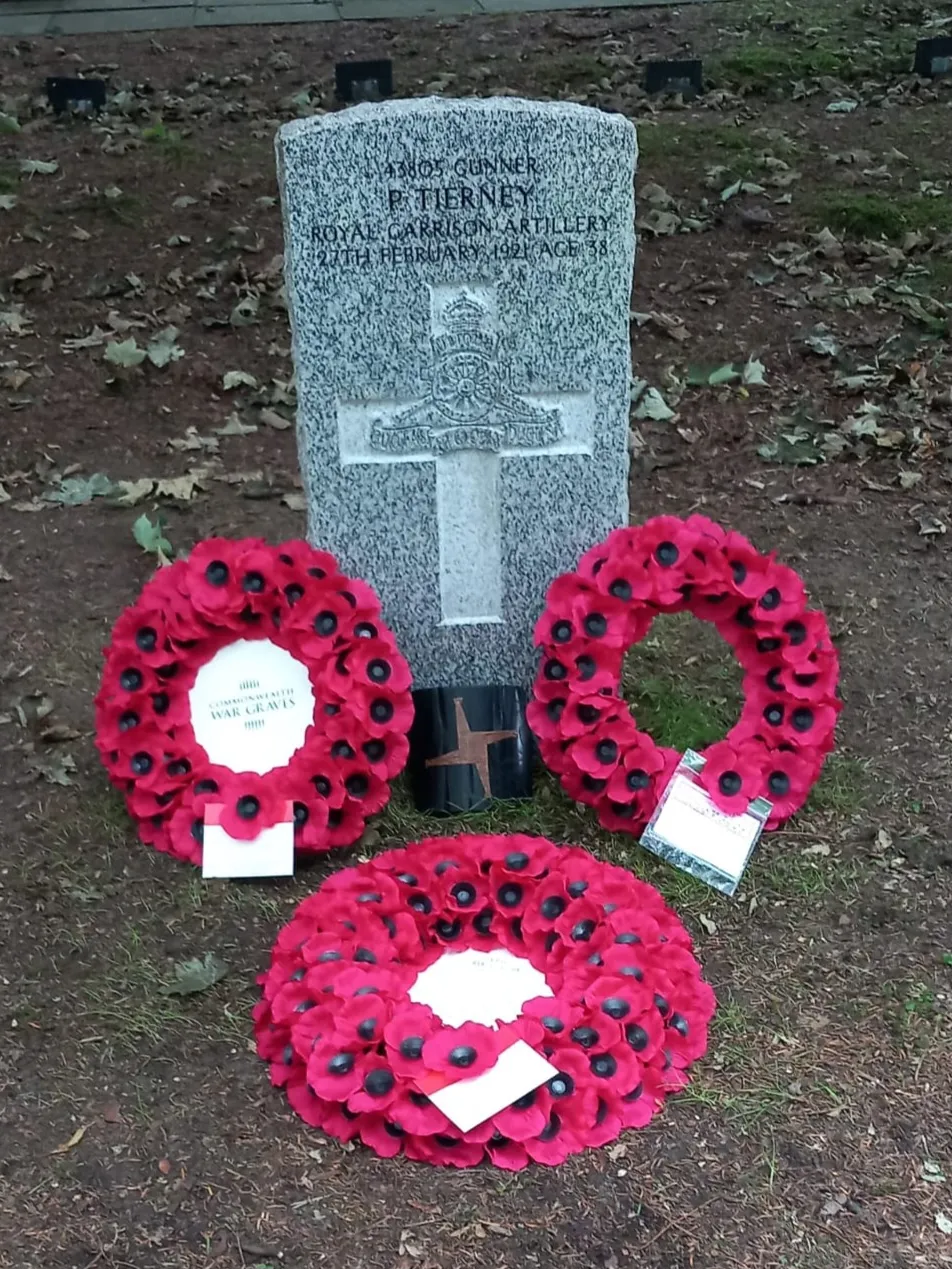 Patrick Tierney’s war grave marker in lair 317. The stone follows the death register’s age of 38. Photo: Tierney family.
Lair 203: Jane Muir Symington
Jane Symington was born in Lesmahagow in 1865 and raised by her grandfather. In October 1888, aged twenty-two, she had a daughter. No father was named on the birth certificate. By 1901 she was a patient at Hartwood, recorded as a former domestic servant.
She died there on 22 March 1914. The cause was given as “Morbus Cordis (unknown)”, disease of the heart. Jane was buried in an unmarked grave. Whether she spent all thirteen years in the asylum, or was discharged and readmitted, nobody now knows.
What put them there
Look at what put these people in Hartwood and what killed them there: a refugee mother after childbirth, a man diagnosed with “religious mania”, a boy who needed help, a former soldier with untreated syphilis, an unmarried mother. Two died of infections that antibiotics now cure.
Every one of them was reduced to a lair number for most of a century. They have their names back now because of volunteers and their own families, not because of any institution that held them.
How a myth is made
Look up Archibald Campbell Clark on Wikipedia today and you will read that he “employed electroconvulsive therapy and was the first person in Scotland to perform a lobotomy in attempts to control behaviour” (Wikipedia, as at 4 October 2026). The same claims run through blogs and urban exploration sites. They are the most repeated facts about Hartwood.
They are not true, and you can trace exactly how they spread.
He could not have done it
Clark died at Hartwood on 28 November 1901.
Egas Moniz carried out the first prefrontal leucotomy, the operation that became known as lobotomy, in Lisbon in 1935. The first in Britain was in Bristol in 1940 (IHR History Lab, 2022). Electroconvulsive therapy was invented in Rome in 1938. Clark had been dead for thirty-four years before anyone performed a lobotomy anywhere, and for thirty-six before anyone gave ECT.
That does not mean Hartwood never used either treatment. Testimony suggests it did. Scottish psychiatry took to lobotomy early: in 1943 one of the country’s most eminent psychiatrists, Professor D. K. Henderson, called it “one of the marvels of modern medical practice” (Gallagher, 2017, p. 34). A man whose father was Hartwood’s GP in the 1940s and 1950s has written that he worked there during his university holidays and “witnessed a lobotomy” (World Abandoned, comment, 2022). Thomas Ritchie was given chlorpromazine at Hartwood in the 1960s (Gallagher, 2017, pp. 40 and 67).
So the real Hartwood used the treatments of its time. It did not invent them, Clark had nothing to do with them, and I have found no evidence anywhere that Hartwood was the first place in Scotland to perform a lobotomy.
Four steps
I have traced the claims back as far as the online record goes. Each step adds something the step before did not say.
Before 2006: a local history page. An early website on the hospital’s history, archived in 2007, called Hartwood “in its heyday the largest mental hospital in Scotland” and said it was “most probably the birth-place of Industrial, Recreational and Occupational Therapies”. Proud and unsourced, but it said nothing of ECT, lobotomy or Europe. It even got Clark’s first name wrong, calling him Alexander (Wayback Machine copy, 5 February 2007).
13 January 2006: Wikipedia. A new Wikipedia article on Hartwood village linked to that page and said that Clark was “broadly accredited with the inception of modern psychiatric therapies such as Occupational Therapy, ECT and industrial involvement”. Occupational and industrial therapy came from the local history. ECT appeared with no source at all. The same article described Hartwood as an eighteenth-century hospital. It opened in 1895 (Wikipedia, Hartwood, first version).
By 2019: an urban exploration blog. A guest post on the site World Abandoned, written by someone who had got past a ten-foot fence to photograph the ruins, said that Hartwood “was the first place in Scotland to perform the lobotomy” and that “by the 1950s, Hartwood was the largest asylum in Europe and one of the most overcrowded in the UK, with over 2,500 patients” (World Abandoned). The largest in Scotland had become the largest in Europe. The lobotomy had arrived. No source was given for either.
5 June 2019: Wikipedia again. A new Wikipedia article on Clark himself took the next step. The lobotomy was no longer something that happened at Hartwood. It was something Clark did: he “employed electroconvulsive therapy and was the first person in Scotland to perform a lobotomy”. The footnote at the end of that passage pointed to Yorston and Shetty’s 2000 study of Clark’s letters. I have read it. It does not mention lobotomy or ECT. The footnote for “the largest asylum in Europe” pointed to the World Abandoned blog post (Wikipedia, Campbell Clark, first version).
From there it spread. It sat on Wikipedia, unchallenged, for seven years. Only on 7 September 2026 did someone finally tag both claims “citation needed”.
Nothing in this chain cites a hospital record, or a medical source that actually says what is claimed.
Largest in Europe
The one claim with an official ring to it is “largest in Europe”. It comes from the state. Historic Environment Scotland’s listing for the building says that “Hartwood was the largest asylum in Europe housing 2,500 residents” (Historic Environment Scotland).
The listing cites four references. The two I have been able to read do not support it. Building up our Health (2010) does not mention the Hartwood asylum at all (Historic Environment Scotland). The Royal Commission’s description calls Hartwood “one of the largest hospital sites in Scotland”. Scotland, not Europe, and a site, not an asylum. The other two are an Ordnance Survey map of 1908 to 1911 and the Dictionary of Scottish Architects. The oldest version of the claim I have found, the local history page, also said Scotland.
The earliest “Europe” I can find is the listing itself. The record for Hartwood’s Nurses’ Home carried the sentence by 29 May 2015, with a note that it had been updated after a review in 2013 (Wayback Machine, 29 May 2015). That is at least four years before the World Abandoned post.
I asked Historic Environment Scotland where the sentence came from. Its designations officer replied: “I can see no immediate source” (Historic Environment Scotland, 5 October 2026). HES is looking further, and I will update this if it finds one.
The numbers do not help the claim. In the year to May 1905, Hartwood’s own annual report gives an average of 897 patients in residence (Hartwood annual report 1904-05, North Lanarkshire Archives). In 1960 Margaret Herbison MP told the Commons that Hartwood and Hartwoodhill together were “the biggest mental hospital in Scotland, with almost 1,500 patients” (HC Deb 26 April 1960). That was her figure, not an official count, and she said Scotland. Where 2,500 does appear in a serious source, it is for the two hospitals together (Gallagher, 2017, p. 33). I have not yet found an official count of Hartwood’s patients at its peak, and I have asked the archive for one.
The others
The shock treatment death in 1924. In 2020 a great-granddaughter wrote online that her great-grandmother’s death certificate recorded “delerious mania for 17 days”, and that the family believed she had died of a cardiac arrest after electric shock treatment, aged 35, in 1924. The death certificate may be exactly right. ECT did not exist until 1938. Asylums did use older electrical treatments, so the family may remember something real, but it cannot have been ECT.
“Many entered, but few escaped.” That was how the Science Channel’s Mysteries of the Abandoned described Hartwood in May 2022, as “a notorious psychiatric asylum” with a “terrifying past” (TVmaze listing). The same local history page that started this chain put Hartwood’s discharge rate in 1901 at around 48%. That figure is unsourced too, and I have asked the archive for the annual reports that would settle it. But nothing I have found supports “few escaped”.
Mass graves. Local rumour has long had it that patients were thrown into mass graves. The Friends of Hartwood Paupers Cemetery, who have been through the burial records name by name, say “there is no evidence of mass or undignified burials” (Friends of Hartwood Paupers Cemetery). Two to a lair, in a shroud, under a numbered iron plate if anything, is not a mass grave. It is not much dignity either.
Giving Hartwood’s dead their names back took volunteers years with the burial books. The myths took a few careless sentences.
A level below which you cannot sink
In 1971 a patient on Hartwood’s geriatric Ward 15 was having a shave. Archie Meek was ninety-one. The man holding the razor was Thomas Ritchie, a state patient who had taken on the job as one of his duties on the ward.
“Christ, Tam,” Meek said. “Whit are us auld men tae dae if ye ever leave us? We’re a’ dividid frae yin anither. Kin ye no start up a union afore ye go? Fur dividid we fa!” (Gallagher, 2017, p. 39)
Ritchie thought the old man had probably been a trade unionist before the Great War. He mentioned the idea, half as a joke, to Felicity Harris of Glasgow Advisory People, a volunteer advice service that had been helping him. She took it seriously. “Why don’t you start a union of mental patients, Tommy? There’s no reason why you shouldn’t.”
So he did.
Fifteen months
Ritchie had arrived at Hartwood in 1963. Lanark Sheriff Court sent him there after a breach of the peace charge, with a restriction that meant only the Secretary of State for Scotland could release him. He was told to expect about fifteen months.
He stayed eight years.
“I certainly didn’t know what I was in for that morning in the Sheriff Court at Lanark,” he wrote. “The effective reality of the matter is that State patients simply do not have any rights.” (Gallagher, 2017, p. 40)
He tried every official channel. In 1967, after some of the men on his ward had gone five weeks without being let outside, he complained to a doctor about the lack of fresh air and the food. He was moved into the sickroom of Ward 7, a locked ward inside a locked ward. “I was not violent. I have never been violent. And the sickroom is supposed to be for violent cases.” He studied from inside the hospital and passed two A-levels in 1969. No job was found for him. The Scottish Home and Health Department had one social worker for every state patient in the country, and when that man fell ill, as Ritchie put it, “the social progress of all the patients in his care also comes to a halt” (Gallagher, 2017, pp. 40 to 41).
By 1971 he could see where it ended. “The conviction grows in many that they will die in hospital (this one).”
Ward 7
What Ritchie wrote down about the place he lived is the only account of Hartwood’s wards from a patient’s side that I have been able to find.
Ward 7 held about 110 men. “With 55 patients, i.e. half the present number, Seven would still be overcrowded.” The wards were ranked, and the rank decided what you wore and what you ate. Fine socks went to the Hill wards. “Patients in 10, 9, 8 and 7 do not get any jam on the table.” Meals in the main hall ran to bells: “bells ringing to summon you for food, bells ring between courses, bells let you know when to go.” He invited the visitors who were taken round on conducted tours to “insist upon being shown the brutes from 7, 8, 9 and 10 at feeding time in the main hall. The midday show is the best, 12.45-13.15” (Gallagher, 2017, pp. 52 and 58 to 59).
Some of the men around him had been there longer than he had. One epileptic man had been sent by the court “for his own safety”, as a stopgap until a place came up in an epileptic home. More than eleven years later he was still there. Another had been held fourteen years for a breach of probation. Some of the state patients said they would rather have gone to prison, because in prison at least you know your release date (Gallagher, 2017, p. 44).
Ritchie also described violence. Staff-to-patient brutality in 1967, he wrote, “was an everyday occurrence not to be remarked upon”, and by 1971 there was still “rather more rough-handling and scruff-of-the-necking than one would expect to see in a hospital” (Gallagher, 2017, p. 46). That is one patient’s account, and I am presenting it as such. But the Mental Welfare Commission itself admitted the following year that it was “rare, but not unknown to find instances of deliberate ill-treatment or wilful neglect” (Gallagher, 2017, p. 46).
Twenty-seven names
On 26 July 1971, twenty-seven patients put their names to a petition demanding “redress of grievances and better conditions” at Hartwood. Most were on Ward 7. Three more were on the closed Wards 8 and 10, and the petition had to be smuggled in to them (Gallagher, 2017, p. 38).
It worked, a little. Commissioners came out from the Mental Welfare Commission’s offices in Edinburgh, heard the complaints and put several personal grievances right. Ritchie drew the obvious lesson: “even to a small united band of 27 the authorities were prepared to give heedful ear, whereas the solitary plaintiff gets nowhere.” The Commission asked for the grievances in writing, and Ritchie wrote them: a manuscript running to almost fifty pages, part autobiography, part charge sheet, part manifesto.
He called the organisation the Scottish Union of Mental Patients. Why Scottish rather than national? “Certainly not for reasons of rabid porridge-and-bagpipes patriotism!” Partly to make the point that Scotland ran its mental health services under its own law and its own department, and ran them badly. But mainly, he admitted, “to contrive the abbreviation SUMP – a level below which you cannot sink” (Gallagher, 2017, p. 48).
The joke was a cover for a serious argument. Nurses had two unions, Ritchie pointed out. Doctors had their professional body. “Indeed the only section which does not speak with a united voice is the one comprising the nuts themselves! – the poor creatures for whom the mental hospitals were built” (Gallagher, 2017, p. 55). This was Lanarkshire in 1971, the summer of the Upper Clyde Shipbuilders work-in. Ritchie listed Clydebank shop stewards among SUMP’s supporters. And patients were already doing the work of labourers, he wrote: “positively exploited as a cheap labour force at harvest time.”
What happened next
Ritchie was released in October 1971. He kept going. He visited Gartnavel and Gartloch to recruit, won support from the Scottish Council for Civil Liberties, and sent his manuscript to Ink, a London underground paper, which printed an extract in November. In March 1972 the Glasgow Herald ran the story under the headline “Special Union to be formed for mental patients”. “I expected to be there for about fifteen months,” Ritchie told the paper, “but I finished up there for eight years.” The membership list reached a hundred names (Gallagher, 2017, pp. 48 to 56).
It wasn’t enough. He had no job, no money and no organisation behind him, and by the end of 1972 he had left Scotland. SUMP lasted about a year.
But it didn’t simply vanish. In March 1973 Ritchie was in a room at Paddington Day Hospital in London for the founding meetings of the Mental Patients’ Union. With him was Robin Farquharson, a former Cambridge academic and SUMP’s first member from outside Hartwood, who died weeks later. The historian Mark Gallagher describes SUMP as “the first ‘mental patients’ union’ in the UK”, two years ahead of London. Not every historian agrees that the Scottish union shaped the London one. But it came first.
I think it is the most important thing that ever happened at Hartwood. Not the towers or the ghost stories. Twenty-seven men on Hartwood’s locked wards, some of them held with no release date, asked to be treated as people with rights, and wrote it down.
In 1970 only 8% of patients in Scotland’s mental hospitals were held compulsorily (Mental Welfare Commission, A Duty to Care, 1972, quoted in Gallagher, 2017, p. 37). Ritchie was one of them. It took another thirty-two years for Parliament to put into law something close to what the men of Ward 7 had asked for: “Every person with a mental disorder shall have a right of access to independent advocacy” (Mental Health (Care and Treatment) (Scotland) Act 2003, s. 259).
Archie Meek had it right in one sentence. Divided, they fell. For one summer in 1971, they weren’t.
The slow emptying
In 1961 the Minister of Health, Enoch Powell, stood up at a mental health conference and told the people who ran the country’s asylums that he meant to close most of them. He described what he was up against: “There they stand, isolated, majestic, imperious, brooded over by the gigantic water-tower and chimney combined, rising unmistakable and daunting out of the countryside” (Powell, 1961, quoted in Gallagher, 2017, p. 37).
He could have been describing Hartwood’s twin towers on the moor above Shotts. But Powell was Minister of Health for England and Wales. Scotland ran its own hospitals, and Scotland decided not to follow him.
Scotland says no
The historian Vicky Long has gone through the Scottish civil servants’ files from the 1960s (Long, 2017).
Scotland had more people in mental hospitals than England, for its size: 4 beds for every 1,000 people against 3.4. Its inpatient numbers peaked at 20,925 in 1956. Officials at the Department of Health for Scotland did not believe the English predictions that the asylums could be emptied, and in 1966 they commissioned their own study. It concluded that the English approach did not apply in Scotland. The Department then chose not to circulate it widely, because it criticised English policy.
The numbers show what followed. Between 1961 and 1968 the number of psychiatric inpatients in England and Wales fell by 14%. In Scotland it fell by 3%. By 1966 there were three local authority hostels for former psychiatric patients in the whole of Scotland. Over the twenty-five years after Powell’s speech, England’s psychiatric inpatient population fell by more than half. Scotland’s fell by 30%.
The money never followed the patients, because the patients never left. Local councils in Scotland had a legal duty from 1960 to provide care and after-care for people with mental illness. In the 1950s their spending on mental health had fallen by a quarter in real terms. In Glasgow, by the late 1970s, the council had provided no hostels, no sheltered housing and no sheltered workshops at all. A Glasgow health board committee in 1978 blamed the “almost total non-fulfilment of social after-care policies” for the city’s dependence on its old hospitals.
F. M. Martin looked back on it in a 1984 study for the Nuffield Provincial Hospitals Trust. England, he said, had promised community care and half-delivered it. Scotland had shown an “excess of complacency”: “nothing has been promised and virtually nothing achieved.” Long’s own verdict is that the Department’s insistence that Scotland’s asylums would carry on for years became a self-fulfilling prophecy.
Inside Hartwood
Long’s detailed evidence comes from Glasgow. Hartwood’s own records for these decades are not public, and they are among the things I have asked the archive for. What has surfaced fits the same picture.
In April 1960, Margaret Herbison MP asked how many qualified occupational therapists worked at Hartwood and Hartwoodhill. The answer from the Secretary of State was none (Hansard, 26 April 1960). By the late 1960s Thomas Ritchie was passing A-levels from a locked ward and being told no job could be found for him. In 1974 a nurses’ union branch wrote to an MP that Hartwood had “wards of up to 120 acute psychotic patients” left in the care of four staff (Hansard, 17 June 1974). In 1988 its nurses and ancillary staff held a token strike, and its services were put out to competitive tender (Hansard, 14 January 1988; Hansard, 27 April 1988).
At Gartnavel in Glasgow in 1976, a member of the hospital’s own rehabilitation committee put it plainly: “rehabilitation as such barely existed in view of the virtual impossibility of patients obtaining outside employment.” The next year the committee’s standing agenda item “employment” was renamed “unemployment”.
The end
Scotland only began planning to close its psychiatric hospitals in the 1990s. In the early 1990s Greater Glasgow Health Board found that its mental health service was more likely to “treat people in hospital and keep people in hospital” than anywhere else in Scotland, or in Britain (Long, 2017).
For Hartwood the end came in stages. The NHS and Community Care Act of 1990 started the closure programme. From 1995 the main building was used only for administration. In 1998 it was vacated and the remaining services moved to Hartwoodhill (Historic Environment Scotland). Hartwoodhill’s official closure came on 24 February 2011 (Gallagher, 2017, p. 33).
The archive that now holds Hartwood’s records says its last patients were “discharged, died or escaped” as late as 2001 (North Lanarkshire Archives). Where they went, how many there were, and how many of them had lived there for decades, is not on any public record I have found.
In 1961 a study for the Ministry of Health predicted that the long-stay patients then in England’s asylums would be gone in sixteen years. Fifty years later, Hartwoodhill’s last psychiatric beds closed.
Scotland now
In 1956 Scotland’s mental hospitals held 20,925 people (Long, 2017). On census day in 2025, every psychiatric, addiction and learning disability bed in NHS Scotland together held 2,941 (Scottish Government, Mental Health Inpatient Census 2025). The asylums are gone.
That is real progress. But read the stories from Hartwood’s cemetery again and ask who is still being held, and why.
Still stuck
Robert Yuill went into an institution at seven and never came out. In March 2026, 67 people with what Public Health Scotland calls “extra support needs”, the group that includes people with learning disabilities, were in hospital in Scotland although they were medically ready to leave. Forty-two had been stuck there for more than a year. Nine had been stuck for at least six years (PA, via Care Appointments, 17 June 2026).
Not one of those nine needs to be in hospital. They are there, in the words of Jackie Baillie MSP, “because they simply can’t get the care they need”. That is the same failure the Glasgow health board described in 1978 as the “almost total non-fulfilment of social after-care policies”, nearly fifty years on.
Across all mental health wards, the 2025 census counted 311 people whose discharge was delayed, for a median of 109 days. Mental health beds were 90% full.
Still held
Detention is rising. In 2024-25, 7,449 episodes of compulsory detention began in Scotland, 3.3% more than the year before. One of the main safeguards on an emergency detention is the consent of a mental health officer, a specially trained social worker. In 2024-25 that consent was obtained in just 38.6% of emergency detentions. The Mental Welfare Commission says it is “concerned at the low rate” (Mental Welfare Commission, Annual Report 2025-26).
Something close to what Ritchie and the men who signed with him asked for in 1971 did eventually become law. Since 2003, “every person with a mental disorder shall have a right of access to independent advocacy” (Mental Health (Care and Treatment) (Scotland) Act 2003, s. 259). I think it is the clearest single gain since Hartwood’s day. But it only works if someone pays for the advocates.
Still children on adult wards
I know a little of what being a child in an institution looks like from the inside. As a primary school boy nobody had diagnosed as autistic, I was sent to Forteviot House, a children’s unit of the Royal Hospital for Sick Children in Edinburgh, and then to Harmeny School in Balerno, then a boarding school for children labelled as having behavioural problems. Staff there mocked me for stimming. Nobody once asked why I did it. I came out the other side, and Robert Yuill never did. But I recognise what happened to him in his notes: a boy slowly rewritten as a problem to be managed (I have written about it here).
In 2024-25, 57 children and young people under eighteen were admitted to adult psychiatric wards in Scotland, 71 admissions in all. Fewer than 13% had access to advocacy that specialised in the rights of children and young people. The Commission was “disappointed to find that access to specialist advocacy remains limited”.
Still poor
Hartwood was built under the Lunacy (Scotland) Act 1857 to house the district’s pauper lunatics: people whose keep was paid by the parish because nobody else could pay it.
The word pauper has gone. The pattern has not. In 2024, 704 people in Scotland died by probable suicide, the lowest number since 2017. The rate in the most deprived communities was 2.5 times the rate in the least deprived (National Records of Scotland, 16 September 2025).
What the cemetery tells us
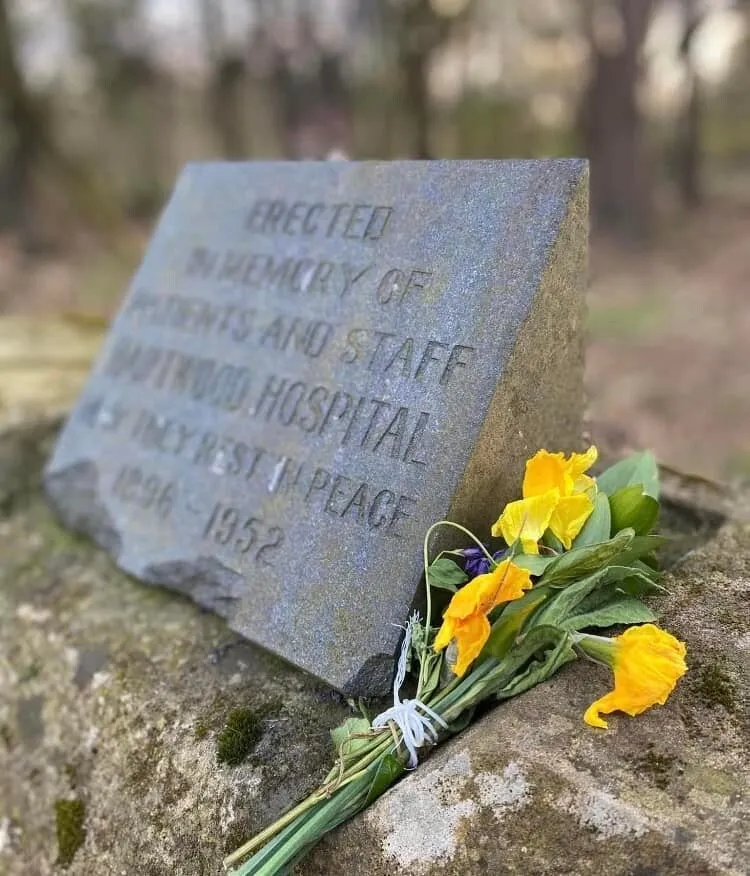 The memorial stone to the patients and staff of Hartwood Hospital. It dates the cemetery from 1896; the Friends put the first burial on 24 August 1895. Photo: Loraine Duncan FoHPC.
The 1,255 people in Hartwood’s cemetery were not there because they were the most dangerous people in Lanarkshire. They were there because they were poor, or disabled, or grieving, or ill with something nobody yet knew how to cure, and because there was nowhere else for them to go.
Scotland no longer buries people in numbered lairs. But it still keeps people in hospital for years because there is nowhere else for them to go, nine of them with learning disabilities or other extra support needs for six years or more, and the poorest are still the most likely to die by suicide.
Who holds the keys now
Hartwood’s doors were locked by a District Lunacy Board, then by the NHS, and for state patients like Thomas Ritchie by the Secretary of State. The people who decide whether someone in Scotland is stuck in hospital today have different titles, but they are just as easy to name: the Scottish Government, the health boards, the councils, and the health and social care partnerships that are supposed to join the two together.
Most of what follows is already in official reports. What is missing is anyone being held to a date.
In 2018 the Scottish Government published Coming Home, a report on people with learning disabilities and complex needs who were stuck in hospital or sent far from home. In 2022 it promised to “significantly reduce” those delays and placements by March 2024 (Scottish Government, 21 February 2022). March 2024 came and went. In March 2026 it published a new action plan and another £20 million, for about 400 people still affected. As reported, it set no new deadline (healthandcare.scot, 20 March 2026).
So here is what I am asking for.
-
A date the Scottish Government can be held to. Nobody who is medically fit to leave hospital should still be there years later because the care they need does not exist. The Government should set a deadline for ending those delays, write it down, and report against it every year until it is met. Nine people who have waited six years or more are owed that much.
-
Advocacy for every child on an adult ward. The law already says every person with a mental disorder has a right to independent advocacy, and it puts the duty to provide it on every health board and every council. Fewer than 13% of the young people admitted to adult wards had advocacy that specialised in children’s rights. Each health board and council should fund it for every one of them, and publish how many got it.
-
Proper safeguards on emergency detention. A mental health officer consented to only 38.6% of emergency detentions in 2024-25. Councils employ these officers. The Government and the councils should fund enough of them that their consent is the normal safeguard it was meant to be, not the exception.
-
An honest account of how Hartwood ended. NHS Lanarkshire sold the site in 2018 (Buildings at Risk Register). It should publish what happened to its last long-stay patients: how many there were, how long they had been there, and where they went. The people buried in the cemetery got their names back because volunteers did the work. The living should not have to wait for the same.
The letters
Hartwood’s first superintendent did not leave us a slogan we can trust. He left a letterbook instead, full of letters to families, plans for fresh air and orders to investigate suspicious deaths. That was the standard the place was founded on, and it is in the archive, in his own hand.
He lies in the corner of the cemetery, among the 1,255.
Named in this piece, or think something here is wrong? Right of reply and corrections.
Comments
Commenting needs a verified email address. Your address is never published and never used for anything else.